Password set successfully

Already have an account? Go to login>
Don't have an account yet? To register>



Semiconductor Warehouse Automation: 150% Higher Storage Density and 60% Fewer Operators
Semiconductor Warehouse Automation: 150% Higher Storage Density and 60% Fewer Operators
In semiconductor manufacturing, production equipment and process flows often receive the most attention. Behind the production line, however, the accurate and timely delivery of materials is equally important to keeping operations on schedule.
At a Southeast Asian factory operated by a leading global semiconductor manufacturer, a warehouse supplies materials to semiconductor packaging lines. It primarily stores leadframes and substrates used in die attach (DA) processes. As material volumes and inbound and outbound activity increased, the warehouse faced slower manual retrieval, time-consuming inventory traceability and growing pressure on storage space.
The warehouse has now completed its automation upgrade and entered operation. As the factory’s first warehouse automation project, it was jointly designed, integrated and delivered by MoveLink and the customer’s team. The solution combines automated guided vehicles (AGVs), high-density racking and warehouse management software to move operations from manual searching to goods-to-person handling.
Before automation: manual retrieval, difficult traceability and limited space
Previously, operators relied on forklifts and manual pallet trucks to move materials. After receiving a task, they entered the warehouse and searched the racks for the required items. As the number of material types and storage locations increased, retrieval and transport required more time and personnel.
Materials also passed through multiple steps between receipt, storage and dispatch. Without unified system records, determining what had happened to an item and where it was currently stored required lengthy searches. Floor storage and low-level racking did not make full use of the building’s height, further limiting capacity as inventory grew.
The project therefore focused on three priorities:
- Reduce reliance on manual searching and transport to improve labor efficiency.
- Give each item a unique identifier and enable end-to-end traceability.
- Use the warehouse’s vertical space to increase storage-location density per unit of floor area.
After automation: AGVs and WMS enable goods-to-person operations
Based on the available space, material specifications and inbound and outbound requirements, MoveLink developed an integrated solution comprising forklift AGVs, CTU carton-handling AGVs, high-density racking, an inbound/outbound workstation and a warehouse management system (WMS).
Forklift AGVs transport palletized loads, while CTU AGVs store and retrieve individual cartons within the racking. Automating retrieval and transport reduced the number of operators required for these warehouse operations by approximately 60%. Operators now focus more on material handovers at the workstation.
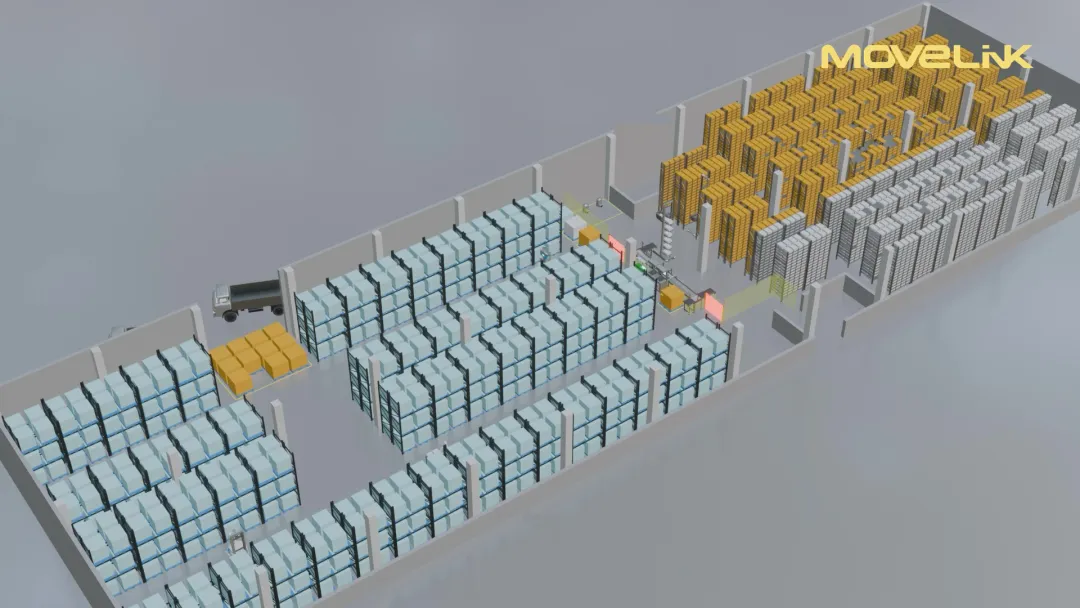
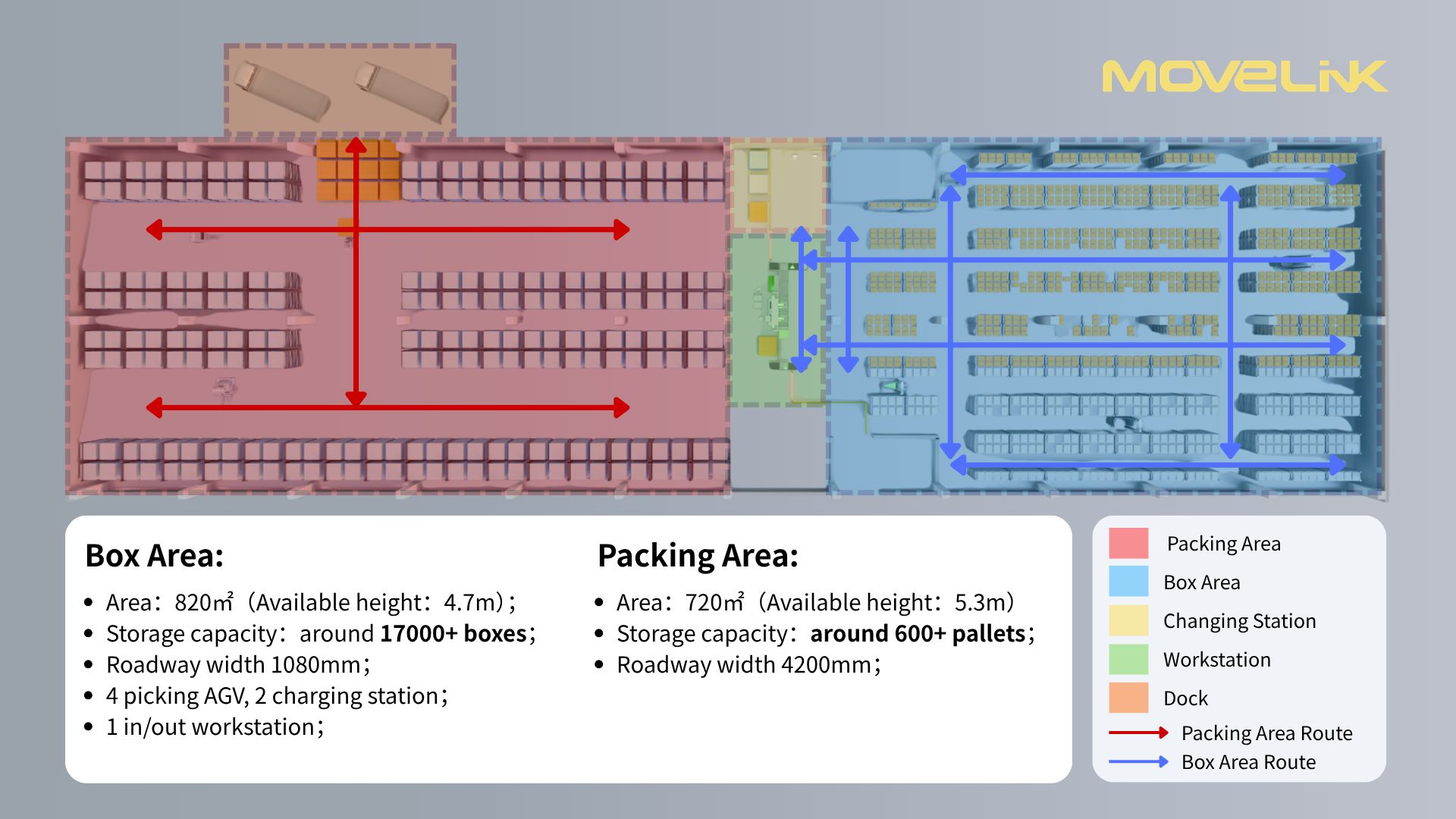
In the carton storage area, loads are depalletized and handled as individual cartons. When the system receives a task, a CTU AGV travels to the assigned location and places or retrieves a single carton directly from the rack, operating in aisles just 1.08 meters wide.
This area was designed with more than 17,000 carton storage locations, four picking AGVs, two charging stations and one inbound/outbound workstation. Combined inbound and outbound throughput reaches 120 cartons per hour, approximately 200% higher than before the upgrade, meeting the site’s material-flow requirements. The core handling equipment has a reported mean time between failures (MTBF) of 1,000 operating hours, supporting the factory’s need for extended, high-frequency material supply.
One system accommodates 17 carton sizes
Leadframes and substrates are stored in 17 different carton sizes. The solution handles the customer’s existing transit packaging while accommodating dimensional differences and matching the customer’s electrostatic discharge (ESD) protection requirements for packaging.
Assigning separate locations and equipment to every carton size would increase system complexity and reduce storage flexibility. MoveLink accounted for carton dimensions in both the rack-location design and AGV handling design, allowing one system to accommodate all 17 sizes.
Cartons of different sizes can be received, stored and dispatched within the same system without dedicated equipment for each packaging size. This also leaves room for future changes in the material mix.
Double-deep storage up to 4.7 meters high
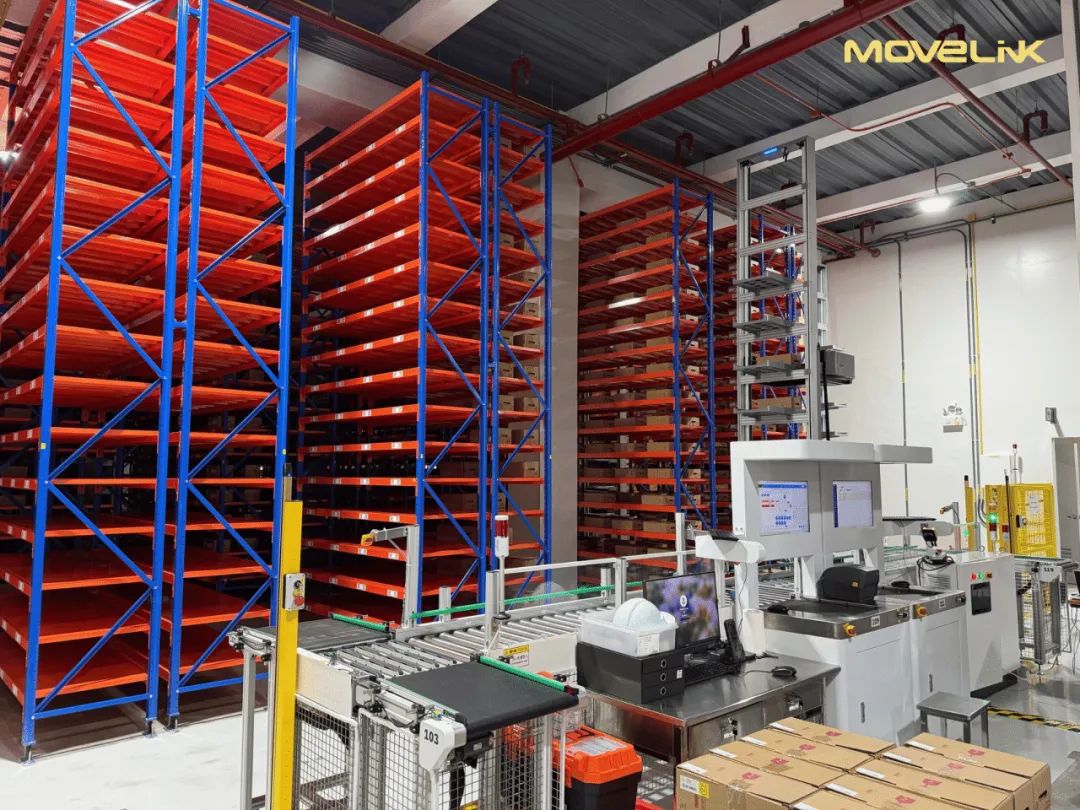
With limited floor space and increasing material volumes, the project made use of the building’s height. Storage locations reach up to 4.7 meters, with a double-deep configuration and separate zones for larger and smaller cartons based on their actual dimensions.
Together, vertical storage, double-deep racking and size-based zoning increased storage-location density per unit of floor area by approximately 150%, expanding capacity without adding floor space.
Unique item identification enables end-to-end traceability
Each item in the automated warehouse has a unique identifier. From receipt and putaway through storage and dispatch, the system continuously records its status, storage location and movement history. Operators can quickly check an item’s current location and related transaction records, reducing batch-tracing time from hours to seconds.
The system supports forward tracking from receipt to dispatch, as well as backward tracing based on production or dispatch results. For packaging materials issued by batch, these records also help verify batch destinations and first-in, first-out (FIFO) order.
Direct WMS–SAP integration connects tasks and data
MoveLink also integrated the WMS with the customer’s SAP system, helping prevent the new automation equipment from becoming a separate information silo.
Inbound and outbound tasks and related data pass directly between the systems. Once a physical receipt or dispatch operation is completed, the records are updated accordingly, reducing duplicate manual entry and improving information flow.
By connecting equipment execution, warehouse management and SAP, the project creates a closed loop from business tasks to on-site operations and data feedback. This aligns physical material movements with system records and achieves inventory accuracy of 99.9%.
Results: better efficiency, space utilization and traceability
| Metric | Before | After |
|---|---|---|
| Operating model | Manual searching; forklifts and pallet trucks | Automated AGV retrieval and goods-to-person handling |
| Staffing | Repetitive searching and transport | Approximately 60% fewer operators required for these warehouse operations |
| Storage | Floor storage and low-level racking | Double-deep storage up to 4.7 m, with size-based zoning; approximately 150% higher storage-location density |
| Throughput | Manual picking and transport | 120 cartons/hour combined inbound and outbound throughput; approximately 200% higher than before |
| Inventory and traceability | Manual inventory and movement queries | Unique item IDs and end-to-end records; 99.9% inventory accuracy; batch tracing in seconds |
| Operational continuity | Dependent on staffing and forklift scheduling | Reported core-equipment MTBF of 1,000 operating hours; supports continuous material supply |
| Semiconductor requirements | Manual ESD, batch and FIFO management | Packaging matched to customer ESD requirements; batch and FIFO management supported |
The shift to goods-to-person operations improved warehouse efficiency and space utilization while establishing batch traceability, packaging compatibility with the customer’s ESD requirements and material-supply capabilities for semiconductor packaging operations.
Cross-regional collaboration and local delivery
Successful overseas implementation depends on more than equipment and solution design. It also requires cross-regional coordination and local delivery capabilities.
For Asia-Pacific projects, MoveLink combines the technical research, development and solution-design capabilities of its Chengdu headquarters with its Kuala Lumpur branch as a regional business and service hub. Local project teams in Southeast Asia support implementation, on-site commissioning, acceptance, handover and ongoing maintenance.
As the factory’s first warehouse automation project, this deployment establishes a foundation for the customer to replicate and expand automation applications. It also adds to MoveLink’s experience in overseas semiconductor manufacturing projects and validates its cross-regional delivery model.
Building on this experience, MoveLink will continue developing its Asia-Pacific presence and automated material handling system (AMHS) solutions for semiconductor manufacturers, supporting warehouse automation, intralogistics automation and production-line upgrades.
Assess the right warehouse automation solution for your facility
If your factory faces slow manual retrieval, limited storage space, difficult material traceability or challenges with overseas project delivery and maintenance, contact MoveLink. We can evaluate your materials, site conditions and workflows to identify a warehouse automation approach suited to your operation.


We Want You
Like minded, resonating with the same frequency, walking together with excellent partners;
This is your ideal growth platform!
Phone number:
E-mail:
info@movelink.com
Address:
Suite 46.03, Level 46, Menara Citibank, 165, Jalan Ampang, 50450 Kuala Lumpur.


Copyright © 2025 Sichuan Liulian Technology Co., Ltd. All rights reserved 蜀ICP备2024113372号-1
